Advertiser Disclosure: WiseIQ is reader-supported. When you apply through links on this page, we may earn a commission at no extra cost to you. Learn more.
PERSONAL LOANS
Best Personal Loans for Medical Bills 2026
PARTNER OFFERFrom 6.3% APRat Upstart · Soft credit check only
📋 By WiseIQ Editorial · Updated September 2026 · Editorially independent
Navigate unexpected medical expenses with confidence. Our expert-reviewed guide helps you find personal loans with competitive rates and flexible terms to cover your healthcare costs.
WiseIQ Expert Tip
Before accepting any loan offer, calculate the total cost of the loan (principal + all interest + fees). A lower monthly payment often means paying thousands more over the life of the loan.
Quick Comparison: Best Personal Loans for Medical Expenses at a Glance
Market Rate Context
National average personal loan APR: 12.35% — The national average is 12.35% APR. Source: Federal Reserve G.19 Consumer Credit Report, May 2026.
Rates verified May 2026 · Updated weekly
Lender
Key APR Range
Min. Credit Score
Fees
Best For
LightStream
6.49% - 24.89%
700+
No fees
Borrowers with excellent credit seeking low rates
SoFi
7.74% - 35.49%
670+
No fees
Unemployment protection and no fees
UpstartOur Partner
6.3% - 35.99%
620+
0%-12% origination fee
Borrowers with lower credit scores or limited credit history
Ultra-low interest rates for highly qualified borrowers.No origination, late, or prepayment fees whatsoever.High loan amounts available, up to $100,000.Fast funding, often as soon as the same day.
Pros
Ultra-low interest rates for highly qualified borrowers.
No origination, late, or prepayment fees whatsoever.
High loan amounts available, up to $100,000.
Fast funding, often as soon as the same day.
Cons
Strict credit requirements, generally 700+ FICO score.
Not suitable for borrowers with fair or poor credit.
Allows joint applications to improve approval odds and rates.
Competitive rates for a wide range of credit scores.
Flexible repayment terms (2 to 7 years).
Direct pay option for debt consolidation.
Cons
Origination fees can apply, deducted from loan amount.
May be challenging to qualify with very poor credit.
Who Should Look Elsewhere
A personal loan is not the right tool for every situation. Consider alternatives if any of the following apply to you:
You have home equity: A HELOC typically offers rates 5–10% lower than personal loans. If you own your home, compare HELOC rates before taking a personal loan.
Your debt is primarily credit card debt: A balance transfer card with a 0% intro APR (typically 12–21 months) will cost less than a personal loan if you can pay off the balance within the intro period.
You need less than $1,000: Most personal loan lenders have minimum amounts of $1,000–$2,000. For smaller needs, a credit union payday alternative loan (PAL) or a 0% APR credit card may be more appropriate.
Your credit score is below 500: Most personal loan lenders — including those that accept "bad credit" — have practical minimums around 500–560. Below this, secured loans, credit-builder loans, or co-signer arrangements are more realistic options.
You are in active bankruptcy: Personal loan lenders will decline applicants in active Chapter 7 or Chapter 13 proceedings. Resolve your bankruptcy first.
🎯
Not sure which lender fits your credit range?
See who actually approves your score range — and the APR to expect.
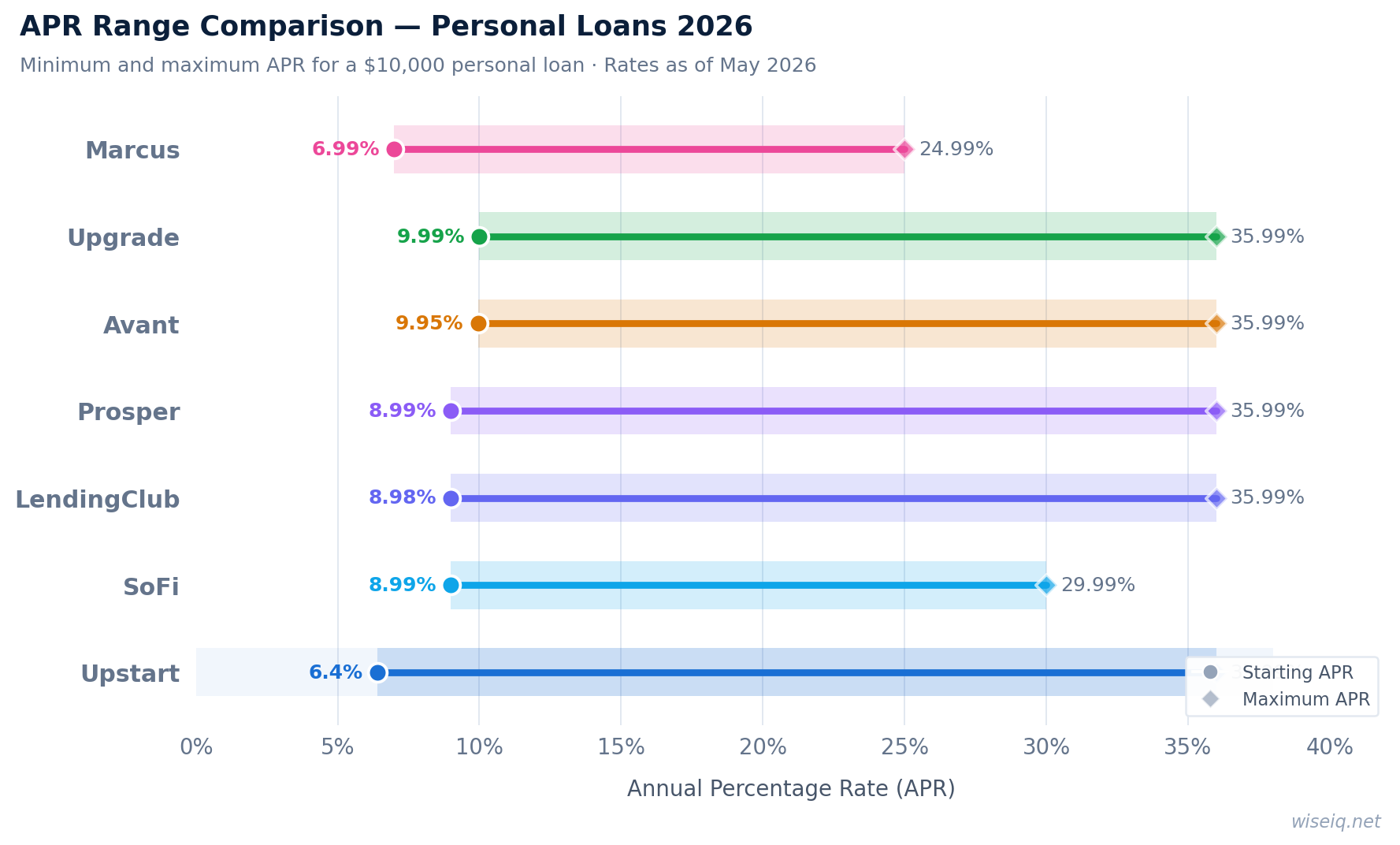
APR Range Comparison: Personal Loans 2026 — Starting and maximum APR for a $10,000 loan. Rates verified May 2026.
How We Chose the Best Personal Loans for Medical Bills
Our Selection Criteria
1. APR and Fees TransparencyWe prioritized lenders offering competitive Annual Percentage Rates (APRs) and clear fee structures, favoring those with minimal or no hidden costs. Transparency in fees, including origination and late payment charges, was a key factor in our evaluation.
2. Credit Score FlexibilityUnderstanding that medical emergencies can affect anyone, we considered lenders that cater to a broad spectrum of credit scores, from excellent to fair. This ensures options are available for diverse financial situations.
3. Funding SpeedIn medical emergencies, time is often of the essence. We evaluated lenders based on how quickly they disburse funds, giving preference to those that offer same-day or next-business-day funding.
4. Customer Support & FeaturesBeyond rates and fees, we looked at additional features like unemployment protection, joint application options, and the quality of customer service and online tools provided by each lender.
Who Should Apply for a Personal Loan for Medical Bills?
Individuals with High-Interest Medical Debt
If you have accumulated medical debt on high-interest credit cards or through other expensive financing options, a personal loan can be a smart move. Consolidating these debts into a single loan with a lower, fixed APR can significantly reduce your monthly payments and save you money on interest over time.
Those Facing Unexpected Medical Emergencies
For unforeseen medical procedures, emergency treatments, or unexpected hospital stays, a personal loan can provide quick access to necessary funds. Lenders offering fast approval and disbursement are particularly beneficial in these urgent situations, ensuring you can cover costs without delay.
Borrowers Seeking Predictable Payments
Personal loans typically come with fixed interest rates and set repayment schedules. This predictability makes it easier to budget and manage your finances, as your monthly payment remains consistent throughout the loan term, unlike variable-rate options.
People with Good to Excellent Credit
If you have a strong credit history, you are likely to qualify for the most favorable terms and lowest interest rates. Lenders like LightStream reward excellent credit with their best offers, making personal loans an attractive option for managing medical expenses efficiently.
We monitor rates across 50+ lenders and alert you when better options become available for your profile.
No spam. Unsubscribe anytime. We never sell your data.
W
WiseIQ Editorial Team
Reviewed by Certified Financial Planners & Industry Experts
Our editorial team consists of financial writers, CFPs, and former banking professionals dedicated to providing accurate, unbiased financial guidance. All content is fact-checked and updated regularly. Learn about our editorial standards →
Frequently Asked Questions
Q: Can I get a personal loan for medical bills with bad credit?
A: Yes, some lenders specialize in loans for borrowers with fair or even poor credit. Lenders like Upstart and Avant consider factors beyond just your credit score, such as your income and education, to assess your creditworthiness. However, be aware that loans for bad credit may come with higher interest rates and fees.
Q: How quickly can I get funds from a personal loan for medical expenses?
A: Many online lenders offer fast funding, with some providing funds as soon as the same business day or within 1-2 business days after approval. This can be crucial when facing urgent medical bills. Always check with the lender about their typical funding timeline.
Q: Are there any alternatives to personal loans for medical bills?
A: Yes, alternatives include medical credit cards (like CareCredit), payment plans directly with healthcare providers, negotiating with providers for a lower cash price, or seeking assistance from non-profit organizations. Each option has its own pros and cons regarding interest rates, repayment terms, and eligibility.
Q: Will applying for a personal loan affect my credit score?
A: Initially, most lenders perform a soft credit inquiry when you check your rates, which does not impact your credit score. If you proceed with a full application, a hard credit inquiry will be made, which may temporarily lower your score by a few points. However, responsible repayment of the loan can positively impact your credit score over time.
Best Personal Loans for Debt Consolidation
Best Personal Loans for Bad Credit
Understanding Personal Loan Rates
People Also Ask
Focus on the Annual Percentage Rate (APR), which includes both interest and fees. Compare minimum credit score requirements, funding speed, loan amounts, and repayment terms. Read recent customer reviews on Trustpilot and the BBB. Getting pre-qualified lets you see real personalized offers.
The interest rate is the base cost of borrowing. APR (Annual Percentage Rate) includes the interest rate plus all fees (origination fees, closing costs, etc.), expressed as a yearly rate. APR gives you a more complete picture of the true cost of a loan — always compare APRs, not just interest rates.
Credit scores have a dramatic impact on rates. On a $20,000 personal loan, the difference between a 720 score (8% APR) and a 580 score (25% APR) is over $9,000 in additional interest over 5 years. Improving your score before applying can save thousands.
Reputable online lenders use bank-level encryption (256-bit SSL) to protect your data. Look for HTTPS in the URL, check that the lender is registered in your state, verify their BBB rating, and read privacy policies before submitting personal information. Avoid lenders who contact you unsolicited.