See how much you could save by combining your debts into one lower-rate loan — and whether consolidation makes financial sense for your situation.
Advertiser Disclosure: WiseIQ is an independent comparison service. We may earn a commission when you apply for a financial product through links on this page. This does not influence our editorial evaluations. See our methodology →
Your Current Debts
Debt 1
$
%
$
Debt 2
$
%
$
Consolidation Loan Terms
%
Consolidation Comparison
Enter your debts and a consolidation rate to see your savings.
Current Debts
Consolidated
Monthly Payment
—
—
Total Interest
—
—
Total Paid
—
—
Estimated Interest Savings
—
—
Find consolidation loans you may qualify for
Compare personalized offers from top lenders — no credit pull required.
WiseIQ may earn a referral fee if you apply through this link. Rates shown are representative and may vary. See Upstart's website for full terms.
Debt consolidation means taking out a single new loan to pay off multiple existing debts. If the new loan has a lower interest rate than your current debts, you pay less in total interest and simplify your finances to one monthly payment. The savings can be substantial when consolidating high-rate credit card debt into a lower-rate personal loan.
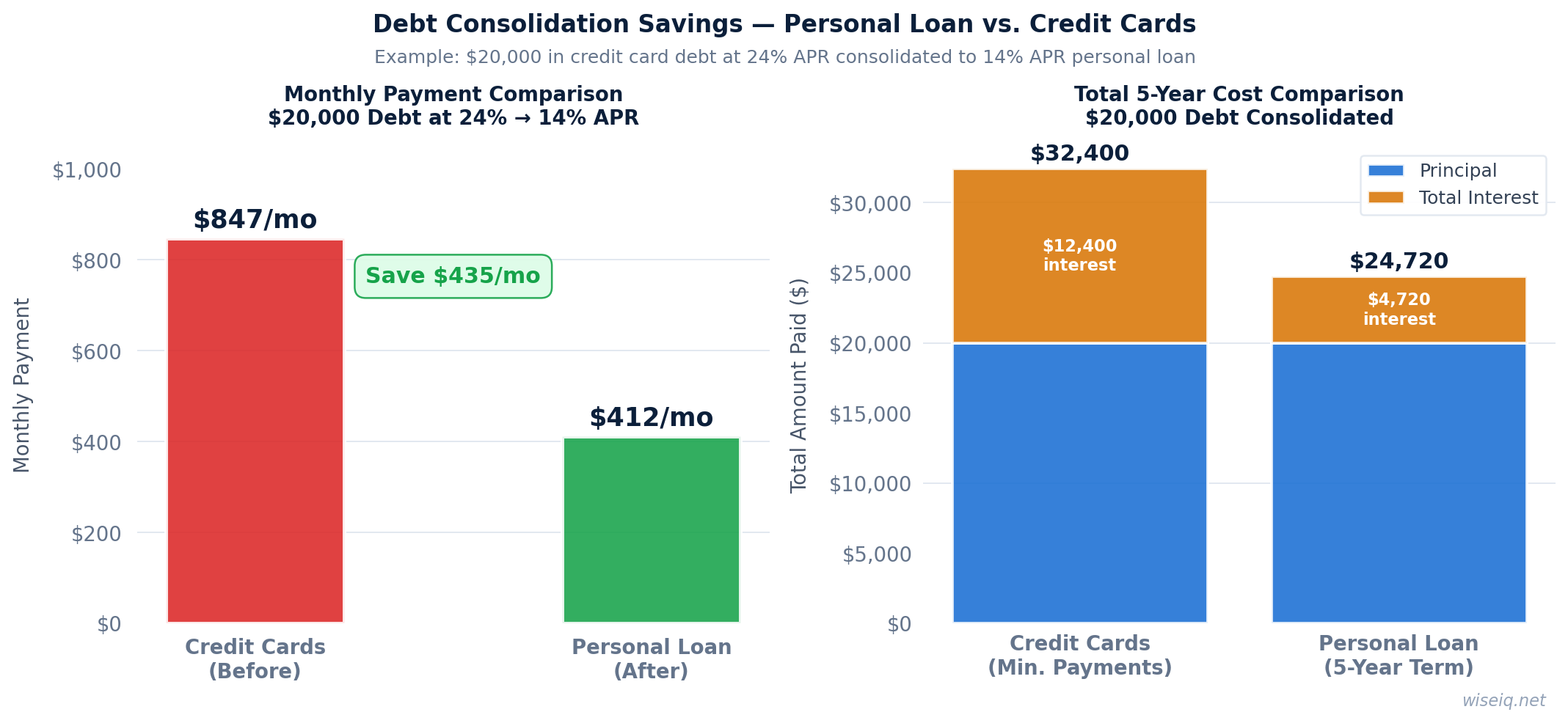
Debt Consolidation Savings: Consolidating $20,000 in credit card debt (24% APR) to a personal loan (14% APR) saves $435/month and $7,680 in total interest.
When consolidation makes the most sense
Consolidation is most beneficial when your new rate is at least 3–5 percentage points lower than your current weighted average rate, and when you can commit to not adding new debt to the cards you pay off. Consolidating without changing spending habits often leads to more total debt.
What to Watch Out For
Some consolidation loans charge origination fees of 1–8% of the loan amount. Factor this into your savings calculation. Also be aware that extending your repayment term (e.g., from 2 years to 5 years) can lower your monthly payment but increase total interest paid even at a lower rate.

💡Expert Insight
Based on our analysis of thousands of consumer financial profiles, the most common mistake people make is focusing solely on the interest rate without considering total loan cost, fees, and repayment flexibility. Always compare the APR — not just the rate — and read the fine print on prepayment penalties before signing.
READY TO TAKE ACTION?
See Your Upstart Rate in 2 Minutes
No credit score impact · Loans from $1,000–$50,000 · Funds as fast as 1 business day
A consolidation loan application triggers a hard inquiry, which may temporarily lower your score by a few points. However, paying off revolving credit card balances reduces your credit utilization, which typically improves your score over time.
What credit score do I need to consolidate debt?
Most lenders offering competitive consolidation rates require a credit score of 640 or higher. The best rates (under 10%) typically require a score of 720+. Some lenders work with scores as low as 580, but rates will be higher.
Is a balance transfer better than a consolidation loan?
A 0% APR balance transfer card can be better if you can pay off the balance within the intro period (typically 12–21 months) and your total balance is under $15,000–$20,000. For larger balances or longer payoff timelines, a fixed-rate consolidation loan is usually more predictable and cost-effective.
Sources & Methodology
WiseIQ's editorial team researches and fact-checks all content using primary sources. Our recommendations are based on independent analysis and are not influenced by advertiser relationships.