Having no credit history — sometimes called a "thin file" — makes it nearly impossible to get approved at traditional banks and most online lenders. Upstart is different. Their AI-based underwriting model was specifically designed to evaluate borrowers who don't have an established credit history, using education and employment data instead.
Financial decisions made with complete information consistently outperform those made under pressure or with incomplete data. Take time to compare at least 3 options before committing.
Who Has No Credit History?
Getting approved and getting funded are two different steps, and most people who lose the loan lose it in between. Three things that decide it:
- Ask for what your score supports. Under a 660 score, $5,000 to $15,000 gets approved far more often than $25,000 and up. A smaller request usually means a real offer instead of a decline.
- Accept and verify the same day. Offers expire. Have a recent pay stub or bank statement ready to upload, and answer the verification email or call quickly.
- The origination fee comes out of the deposit. It runs 0% to 12%. A $10,000 loan with an 8% fee puts $9,200 in your account, so size the request with the fee in mind.
Why Upstart Works for Thin-File Borrowers
Upstart was founded with the specific goal of expanding access to credit for people who are creditworthy but lack a traditional credit history. Their model has been shown to approve 27% more borrowers than traditional credit score-based models, with 16% lower APRs on average.
Key insight: A recent college graduate with a degree in engineering and a job offer at a tech company is a low credit risk — even with no credit history. Upstart's AI recognizes this. Traditional lenders don't.
Who Upstart Is Best For
⚠️ Not a fit if: you need a secured loan, have a bankruptcy in the last 12 months, or need more than $50,000.
What Happens When You Click — 3 Steps
💡 Expert Tip: Check Your Rate Before You Commit
Upstart offers prequalification with a soft credit pull — meaning you can check your rate in minutes without any impact to your credit score. Before applying, review your debt-to-income ratio (DTI): Upstart looks for a DTI below 45–50%. Divide your total monthly debt payments by your gross monthly income to calculate yours. A lower DTI improves your approval odds and typically results in a lower APR.
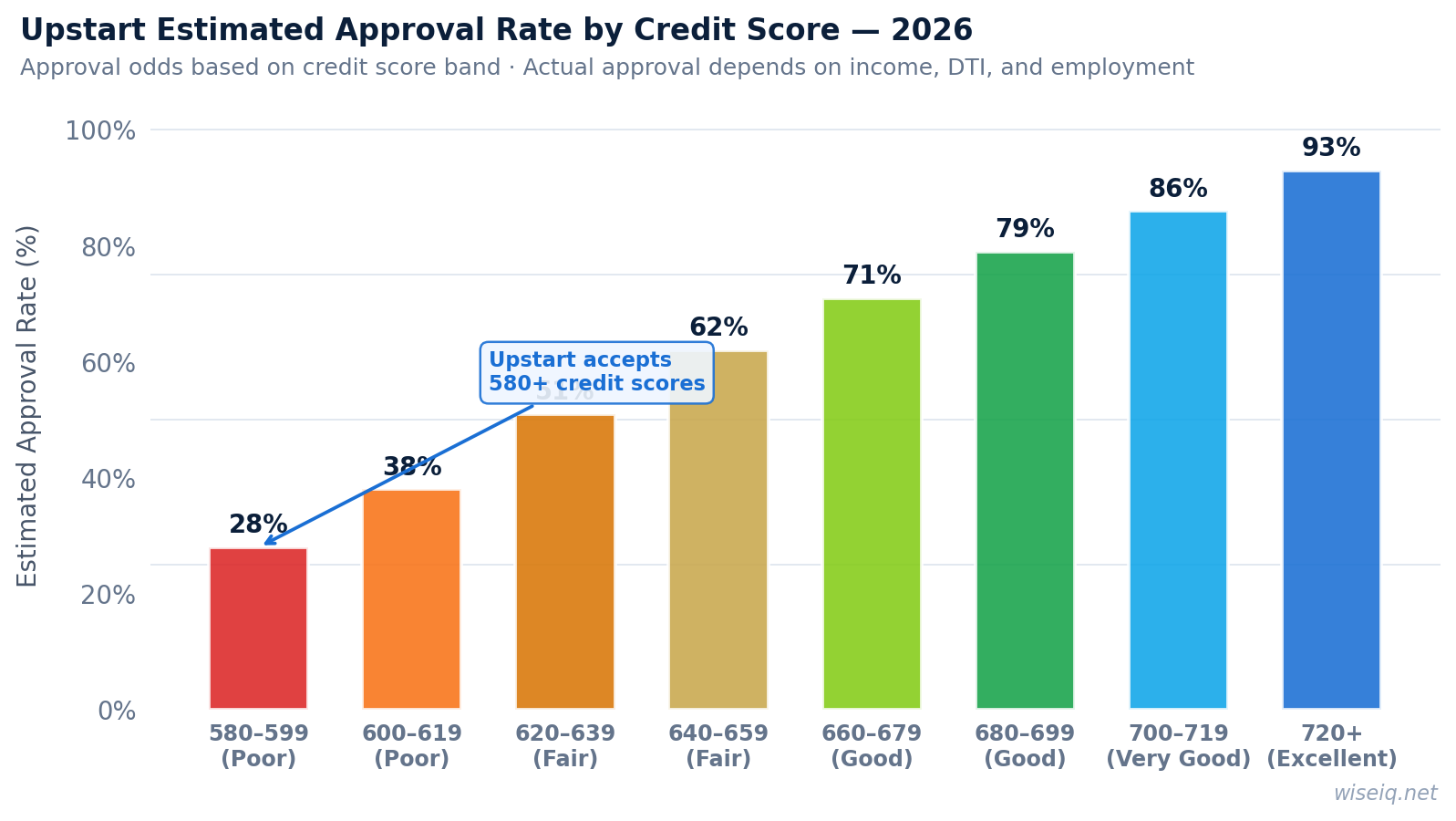
See who actually approves your score range — and the APR to expect.
You're invisible, not risky — and the fix takes 90 days
Roughly 26 million American adults are "credit invisible" — no file at all — per CFPB research, with millions more too thin to score. Here's the distinction that matters: a thin file is not a bad file. Someone who's never borrowed isn't the same risk as someone who borrowed and didn't pay. Traditional scoring just can't tell the difference, because it has nothing to read. That's a data problem, and data problems are fixable on a schedule.
You have two moves, and they're not exclusive. The first is applying with a lender whose model reads more than the file — Upstart weighs education and employment, which is why thin-file borrowers get approved there when a bank's scorecard shrugs. The second is becoming visible on purpose, so that every lender can read you in about 90 days:
2. Authorized user on a family member's oldest card. You inherit its history without them handing you the card. One phone call, zero dollars.
3. Report the bills you already pay. Rent and utility reporting services turn payments you're making anyway into file history — here's how rent reporting works.
Ninety days later you're not asking a lender to take a leap of faith — you're a file with three tradelines and a perfect payment record. Short history, but readable. And readable is the entire game.
Frequently Asked Questions
WiseIQ may earn a referral fee from some lenders on this page. This does not influence our editorial ratings or recommendations. Our reviews are independently researched and editorially independent. Updated September 2026.
 Upstart